ES922
ES922 – CAN FD Module
The ES922 CAN FD module provides two additional CAN FD interfaces for the compact ES910 Prototyping and Interface Module. It is plugged into the extension slot of the ES910.3 module.
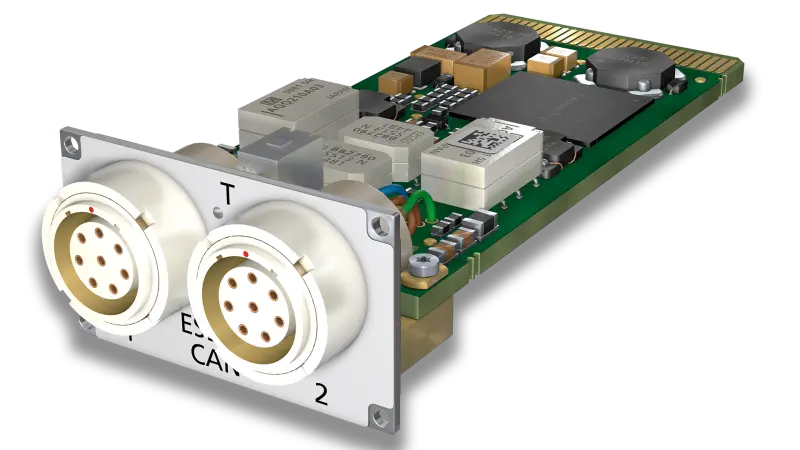
The two CAN interfaces can be configured individually into High Speed or Low Speed CAN buses. The module supports only the High Speed bus when used as a CAN FD interface. The High Speed bus is connected via the TJA1044G transceiver and the Low Speed bus via the TJA1055 transceiver.
The module supports the ISO-compliant as well as the non-ISO-compliant version of the CAN FD protocol.
For a rapid prototyping experiment, an ECU bypass can be configured with INTECRIO using the CAN FD-I/O function or the XCP-on-CAN FD bypass function. By using the two additional CAN FD interfaces of the ES922 module, a prototyping function of the ES910 module can be connected to two further CAN buses in a vehicle network.
For measurement and calibration purposes, the ES922 CAN FD interfaces can be used with INCA to gather data from the vehicle bus. INCA versions 7.2.6 and higher provide measurement and calibration support for the ES922 module. For example, an ECU connected to a CAN FD bypass via the ES910 module can be simultaneously calibrated with INCA.
CAN FD
CAN FD (CAN with flexible data rate) is an improved, backward-compatible CAN protocol developed by BOSCH. The principle differences to CAN are the increased payload data per message from 8 to 64 bytes, higher transfer rates of up to 8 Mbit/s, and longer checksums which, in turn, increase the reliability of the transfer. CAN FD satisfies the automobile industry’s demand for networks with higher bandwidths. At the same time, CAN FD nodes can be easily integrated into existing CAN infrastructure.
Functions
- CAN extension module for ES910.3
- Two electrically isolated CAN FD interfaces
- TJA1044G and TJA1055 transceivers to connect to the High Speed and Low Speed CAN buses
- Baud rate of up to 5 MBd for CAN FD, up to 1 MBd for High Speed CAN, and up to 125 kBd for Low Speed CAN
- The module supports the ISO-compliant as well as the non-ISO-compliant version of the CAN FD protocol.
- FPGA-based CAN/CAN FD communication controller
- LED on the ES922 front panel indicating CAN FD communication
- Wake-up through traffic on the High Speed CAN FD bus
- Supported by INCA
Technical data
| Size and Weight | |
|
Size and Weight
Dimensions (HxWxD)
|
20 x 35 x 83 mm /0.79 x 1.38 x 3.27 in
|
|
Size and Weight
Weight
|
50 g/0.11 lb
|
|
Size and Weight
Environment
|
|
|
Size and Weight
Temperature range
|
-40 °C to +50 °C / -40 °F to +122 °F (operation)
|
|
Size and Weight
|
-40 °C to +85 °C/-40 °F to +185 °F (storage)
|
|
Size and Weight
Power supply
|
|
|
Size and Weight
Input voltage
|
3.3 V /5 V
|
|
Size and Weight
Power consumption
|
0.85 W (typically)/1 W (max.)
|
|
Size and Weight
Stand-by current
|
< 0.7 mA
|
|
Size and Weight
CAN bus interface/CAN FD header
|
|
|
Size and Weight
Channels
|
2 independent channels
|
|
Size and Weight
CAN FD
|
Each channel is separately configurable either as High Speed CAN FD or as Low Speed CAN
|
|
Size and Weight
High Speed CAN
|
TJA1044G transceiver
|
|
Size and Weight
|
5 MBd maximum baud rate for CAN FD with a bus length of up to 20 m
|
|
Size and Weight
|
1 MBd maximum baud rate for High Speed CAN with a bus length of up to 20m
|
|
Size and Weight
|
Differential internal resistor of 10 kΩ
|
|
Size and Weight
Low Speed CAN
|
TJA1055 transceiver
|
|
Size and Weight
|
125 kBd maximum baud rate
|
|
Size and Weight
|
Internal 2.2 kΩ termination resistors
|
|
Size and Weight
Electrical isolation
|
Both channels are electrically isolated from each other and from other circuitry
|
|
Size and Weight
Communication controller
|
FPGA-based
|
|
Size and Weight
Wake-up
|
Wake-up and sleep function on High Speed CAN (FD) bus
|
|
Size and Weight
Comfort features
|
|
|
Size and Weight
LEDs
|
For quick status checks on the CAN bus
|
|
Size and Weight
Support by ETAS Software
|
|
|
Size and Weight
MCD applications
|
INCA V7.2.6, HSP V11.6.0, and higher
|
|
Size and Weight
MCE applications
|
INCA V7.2.7 and higher
|
|
Size and Weight
Rapid prototyping
|
INTECRIO V4.6.3 and higher
|
This product has been developed and released for use in automotive applications. For usage in other domains please contact your ETAS representative.


Contact us
Do you have any questions? Feel free to send us a message. We will be more than happy to help. Contact us today!